Effectiveness of VR robotic training
Robotic surgery is becoming increasingly common, requiring surgeons to develop unique skills distinct from traditional techniques. Simulation training supports the development of these skills while enhancing patient safety. University of Texas Southwestern (UTSW) Medical Center conducted a study to assess the feasibility, effectiveness, and skill transferability of a VR robotic simulator for surgical resident training.
Radi I, Tellez JC, Alterio RE, Scott DJ, Sankaranarayanan G, Nagaraj MB, Hogg ME, Zeh HJ, Polanco PM. (February 22, 2022) Feasibility, Effectiveness and Transferability of a Novel Mastery-based Virtual Reality Robotic Training Platform for General Surgery Residents. Surgical Endoscopy 36(10): 7279–7287.
https://doi.org/10.1007/s00464-022-09106-z
Practical training is a fundamental component of medical education. The knowledge and experience gained during this stage are crucial to minimizing errors in future. The use of VR for surgical training provides an effective and safe environment to build and improve trainees’ technical and manual skills.
VR robotic training for students
Comprehensive surgeon training is essential at the resident level. Robotic-assisted surgery (RAS) provides benefits such as tremor reduction, improved dexterity, and 3D visualization, but it also demands specific skills development. Unexperienced operators may have problems overcoming challenges like limited haptic feedback and complex system operation.
From 2019 to 2021, the University of Texas Southwestern (UTSW) Medical Center implemented a novel VR curriculum aimed at developing core robotic surgery skills among residents. Residents performed 33 SimNow® VR tasks until achieving a composite score ≥90 (out of 100), defined as mastery.
The VR tasks included Around the World Needle Driving, Big Dipper Needle Driving, Ring Roller Coaster 4, Knot Tying, and Three-Arm Relay 3. The first 4 tasks were chosen due to similarity with the inanimate tasks.
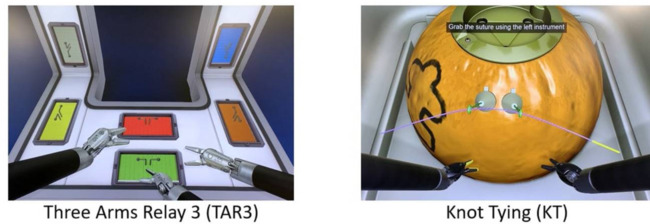
The training resulted in 83% of trainees achieving mastery on all 33 VR tasks. Compared to the pretest, improved performance was observed on the posttest in every VR metric on every task when considering all trainees as a group, when considering only the PGY2s, and when considering only the PGY4s.
A clear improvement in overall performance across all four virtual reality tasks was observed. At the same time, task completion time was substantially reduced, and economy of motion showed marked improvement. These findings suggest that training on the VR platform enhanced residents' psychomotor control, resulting in more effective and efficient task execution.
Improvements through VR
The use of virtual reality for surgical training provides an effective and cost-efficient method to improve trainees’ technical skills. Through immersive and interactive simulations, VR allows students to practice surgical procedures repeatedly in a controlled, risk-free environment.
This continuous exposure helps them improve precision, hand-eye coordination, and decision-making abilities without the limitations of real operating room time. VR training reduces the need for physical resources and supervision, making it a practical tool for institutions with limited access to surgical equipment.
This transferability of skills from a virtual to a real environment confirms the positive implications of the use of VR simulation as a major initial component of robotic surgical training. Although limited by its single-center, the study provides strong evidence that VR-based robotic training is an effective and scalable method for early surgical education. Future research should focus on validating VR performance metrics and assessing skill transfer to real operating room settings.
For more information, contact
info@medicalholodeck.com
February 2022